I’ve Never Dieted a Day In My Life But I Spent Years Trapped in Diet Mentality Before Becoming a Dietitian
Here’s How to Recognize It, What It Can Cost You, and Simple Steps You Can Take Towards a Healthier, Happier Relationship with Food
It took me years of self-reflection and practicing self-compassion to admit to myself that I haven't always had a healthy relationship with food or my body.
For much of my life, I did. But that changed in my early 20s, when I set out to get in shape for my wedding and ended up falling into the grips of diet culture. Shortly afterwards, I became a vegetarian, convincing myself and everyone around me for nearly a decade that it was for my health. Deep down, I knew it was really about trying to be smaller (even though I was already thin).
My relationship with exercise was even more entangled with my desire to control my body size. I pushed myself in the gym every single day, even while pregnant with my third child in four years, taking intense boot-camp classes right up until the day I gave birth. Probably only a week later, I was back at the gym ignoring my body's need to rest and heal in my desperation to "bounce back."
More generally speaking, I took pride in being "the healthy one" among family and friends. I was often praised for my discipline and good choices and became the go-to person for healthy eating tips even though at the time I had absolutely zero qualifications. The truth was, I had an extremely narrow and rigid view of what it means to be healthy. In other words, healthy was a pseudonym for thinness that overlooked very important aspects of physical, mental, social, and emotional wellbeing. I had little understanding of the fine line between pursuing health and disordered eating or exercise.
I was never "a dieter" in the traditional sense. I didn't do Weight Watchers or count calories or follow a specific plan. But I was deeply impacted by diet culture, and it took me years, and eventually becoming a registered dietitian and learning about Intuitive Eating, to see it and then transform my relationship with food and my body.
I'm sharing this because our stories matter. And because diet mentality is sneakier than most people realize. You don't have to be on a diet to be deeply affected by diet culture or to be struggling with a restrictive and harmful diet mentality.
What Is Diet Mentality — And How Is It Different from Simply Eating Well?
Diet mentality is a way of thinking about food, eating, and your body that’s rooted in external rules rather than internal wisdom. It's the belief, often so normalized that it feels like common sense, that your food choices need to be controlled, earned, justified, or atoned for in order to achieve or maintain the “right” weight.
It's important to distinguish this from simply caring about your health or making thoughtful food choices. Wanting to nourish yourself well is not diet mentality. The difference lives in your relationship with food and how it impacts your health and daily quality of life.
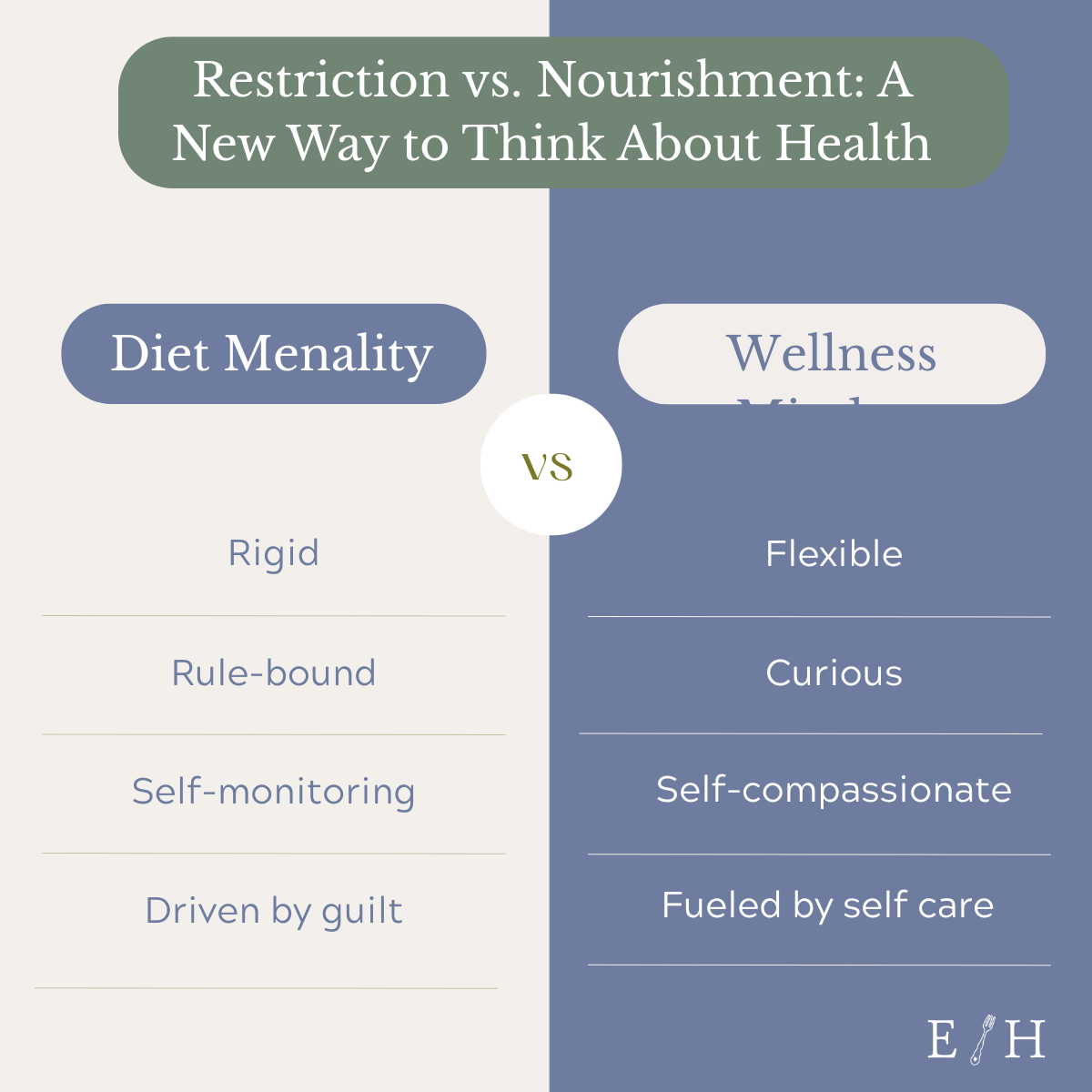
A true wellness mindset is flexible, curious, and self-compassionate. It leaves room for pleasure, for imperfection, for a slice of birthday cake without mental gymnastics afterward. Diet mentality, in contrast, is rigid, rule-bound, and relentlessly self-monitoring. It turns eating into a performance that you're always at risk of failing.
The tricky part is that diet mentality may not include traditional dieting. As I shared with my own personal story, it can look like "clean eating" or being the disciplined person in your friend group who’s praised for her self-restraint, willpower, or commitment to health even though those same things are triggering guilt, stress, or an unhealthy obsession with food, calories, or ingredients.
The Warning Signs of Diet Mentality — Including the Ones That Don't Look Like Dieting
My own personal experience and clinical work helping hundreds of people heal their relationship with food, has taught me that diet mentality exists across a wide spectrum. Some signs are obvious. Others are so normalized that they may barely register as a problem, at least initially.
Here are some of the most common ways diet mentality shows up:
Food has a moral value in your mind. You use words like good, bad, clean, cheat, or guilty pleasure to describe what you eat, and those labels trigger strong feelings about who you are as a person. Eating a salad feels virtuous. Eating a cookie means you "slipped up."
You eat by the clock or the plan, not by hunger. You're eating because it's noon, because your app says you have 200 calories left, or because today is a rest day so you shouldn't eat as much instead of because your body is signaling that it needs food.
Your relationship with exercise feels all about earning or burning calories. Movement feels like something you have to do to justify what you ate or to "work off" the weekend. A missed workout triggers guilt, stress, or anxiety rather than neutral acknowledgment.
You restrict mentally even when you eat freely. This is one of the most hidden forms of diet mentality. You're eating all the foods, but while you're eating them, you're telling yourself you shouldn't be, planning how you'll compensate later, or bracing for the guilt before you even finish the last bite. In Intuitive Eating, we call this mental restriction and it’s a key component that can keep you feeling out of control around food and stuck with an unhelpful diet mentality running the show even when there's no official "plan" in place.
Your body feels like something to manage, shrink, or control. You monitor it carefully. Changes in how your clothes fit feel like failures. A "good" body day has disproportionate power over your mood or sense of self worth.
You feel pride in being "the healthy one." Restriction is dressed up as virtue and discipline. People compliment you for it, which makes it harder to question.
You restart on Mondays. Or after vacation. Or after a birthday dinner. You’re constantly trying to get back on track.
Certain foods feel dangerous. Not because of an allergy, but because you don't trust yourself around them. You avoid keeping them in the house because when they’re there, you can’t stop thinking about them and may end up bingeing them. (More on what's actually happening there in a moment.)
You feel anxious eating outside of your routine. Restaurants, parties, holidays, travel, or any other situations where you can't fully control what's on your plate create stress rather than pleasure.
If one or two of these things feel true for you but, overall, you have a healthy, peaceful relationship with food and your body, that’s not necessarily harmful. However, if you recognize yourself in many of these scenarios, if it feels like food takes up way more energy and mind space than you’d like, or you find yourself withdrawing from other areas of your life because of rigidity around food, these may be signs that you’re struggling with diet mentality. If so, it’s not your fault. Rather, you've absorbed and internalized the messages of a culture that’s deeply rooted in weight bias.
What Diet Mentality Actually Costs You
The harms of diet mentality are real and can be far-reaching.
If it involves chronic restriction, as it so often does, it can trigger the restrict-binge cycle, contribute to weight cycling (the yo-yoing up-and-down that research has linked with increased cardiovascular risk), lead to nutrient gaps, or result in disordered eating or an eating disorder. Diet mentality can also disrupt your connection to your body’s hunger and fullness cues. When you're eating by external rules, whether it’s a plan, a schedule, a calorie target, or a list of allowed foods, you stop needing to listen to your body and over time those internal signals can get harder and harder to hear.
Psychologically, the costs accumulate in ways that are harder to see but no less important. Diet mentality is mentally and emotionally expensive. The constant monitoring, calculating, and negotiating with food can take up significant mental real estate. That means bandwidth you could be directing toward work, relationships, creativity, or other areas of your life get funneled into being preoccupied with food or your weight instead. Studies on dietary restraint, the clinical term for the conscious, ongoing effort to restrict what you eat, consistently links this way of thinking with lower self-esteem and heightened anxiety around food and eating situations.
Socially, diet mentality can shrink your world. You may find yourself avoiding situations where you can't control what's served, eating before you go to parties, so you won't be tempted with “bad” foods, or feeling a flash of resentment when plans change your routine. Food is one of the primary ways human beings connect, celebrate, and care for each other. When eating is a source of anxiety rather than pleasure, it can take a toll on your emotional and mental wellbeing.
Perhaps the most overlooked cost is what diet mentality communicates to the people around you, especially kids and teens, who are extraordinarily perceptive. They notice when a parent won't eat certain foods or is always “being good” or “on a diet.” They absorb comments about bodies—yours, theirs, others’. They can internalize the idea that food has moral value long before they have the language to name it. Research links parental dieting behaviors with higher rates of disordered eating patterns in children. This isn't said to create guilt. I’m pointing it out because wanting to end the legacy of diet culture within their own families is one of the most powerful reasons I've seen for women to finally decide they’re ready to heal their relationship with food.
The Piece Nobody Talks About: Letting Go of Who You've Been
One of the most significant barriers to releasing diet mentality isn't about food at all. It's about identity.
If you've been "the healthy one" for years, the person who always knows what's in everything, who orders carefully at restaurants, who meal preps on Sundays, and skips dessert and gets up early to work out, it can be extra challenging to give up that identity you’ve probably been praised for. If you’ve always been on a diet, the idea of stopping may spark fears that you’re giving up, letting yourself go, or people will judge you for it.
I want to say this clearly and I really hope you can hear it. Letting go of diet mentality is not abandoning your health. It’s not choosing chaos or indifference. It’s exchanging a framework that’s built on external signals and a quest for self-control for one that’s built on internal trust and the notion of pursuing self-care. Not all dieting behaviors are healthy, and not all healthy behaviors result in weight loss but that doesn’t mean they can’t be very impactful for your health.
There can also be a social dimension to this. Diet culture talk is everywhere, including at the office, family dinners, at the gym, or even church. When you opt out, you may initially feel like you're opting out of belonging. Someone makes a comment about "being bad" at dinner, and now you're the awkward one who doesn't engage. A colleague announces a weight loss challenge, and you don't join.
Navigating this takes practice. It helps to find communities that embrace a genuinely different mindset, one where people are invested in health without the weight focus, where food talk isn't moralized, and where there’s room for all bodies. Those communities exist. (My free Facebook group, Health and Healing with Intuitive Eating or my podcast co-host Tara De Leon’s boutique fitness studio is one of them!)
What Replaces Diet Mentality? What Does Food Peace Look Like Day to Day?
These are the two questions I hear most often, and the one that most other resources on diet mentality leave unanswered. "Stop following diet rules" is not a plan. So, what is?
The framework I work within is Intuitive Eating, an evidence-based approach to food and health developed by registered dietitians Evelyn Tribole and Elyse Resch. Intuitive Eating is not a diet dressed up in gentler language. It's a fundamentally different way of relating to food and your body built on ten principles that work together to restore self-trust and the internal eating wisdom you were born with.
In practical terms, moving away from diet mentality means:
Learning to recognize and respond to hunger and fullness cues instead of dieting rules
Making peace with foods that feel "dangerous" — not by eating them until they're no longer interesting (though that often does happen), but by removing the forbidden status that makes them feel so charged
Releasing food guilt, stress, or anxiety
Separating movement from body shape and size and reconnecting with movement for pleasure, health, and self-care
Practicing gentle nutrition — nourishing yourself in ways that feel good and support your long-term wellbeing without the rigidity of rules about what you can or can't eat
Building a more respectful relationship with your body and simple, enjoyable healthy habits that you can and hopefully even want to stick with
As you can see, moving away from diet mentality does not mean abandoning all intention around food. Eating well in a sustainable way requires some level of forethought and planning. The difference is Intuitive Eating is rooted in flexible intention rather than rigid rules. One supports you; the other controls you.
If you’re wondering whether this approach is possible with a health condition, perhaps whether you can eat Intuitively when you have PCOS, high blood sugar, elevated cholesterol, or other medical conditions that your doctor says requires dietary changes, the answer is yes. A weight-neutral, non-diet approach to managing health conditions is evidence-based and effective. It can help you address the same underlying health concerns without the psychological toll of restriction. This is exactly the kind of individualized work I do with clients, and it looks different for every person.
First Steps Toward Food Freedom — That Do Not Involve Another Set of Rules
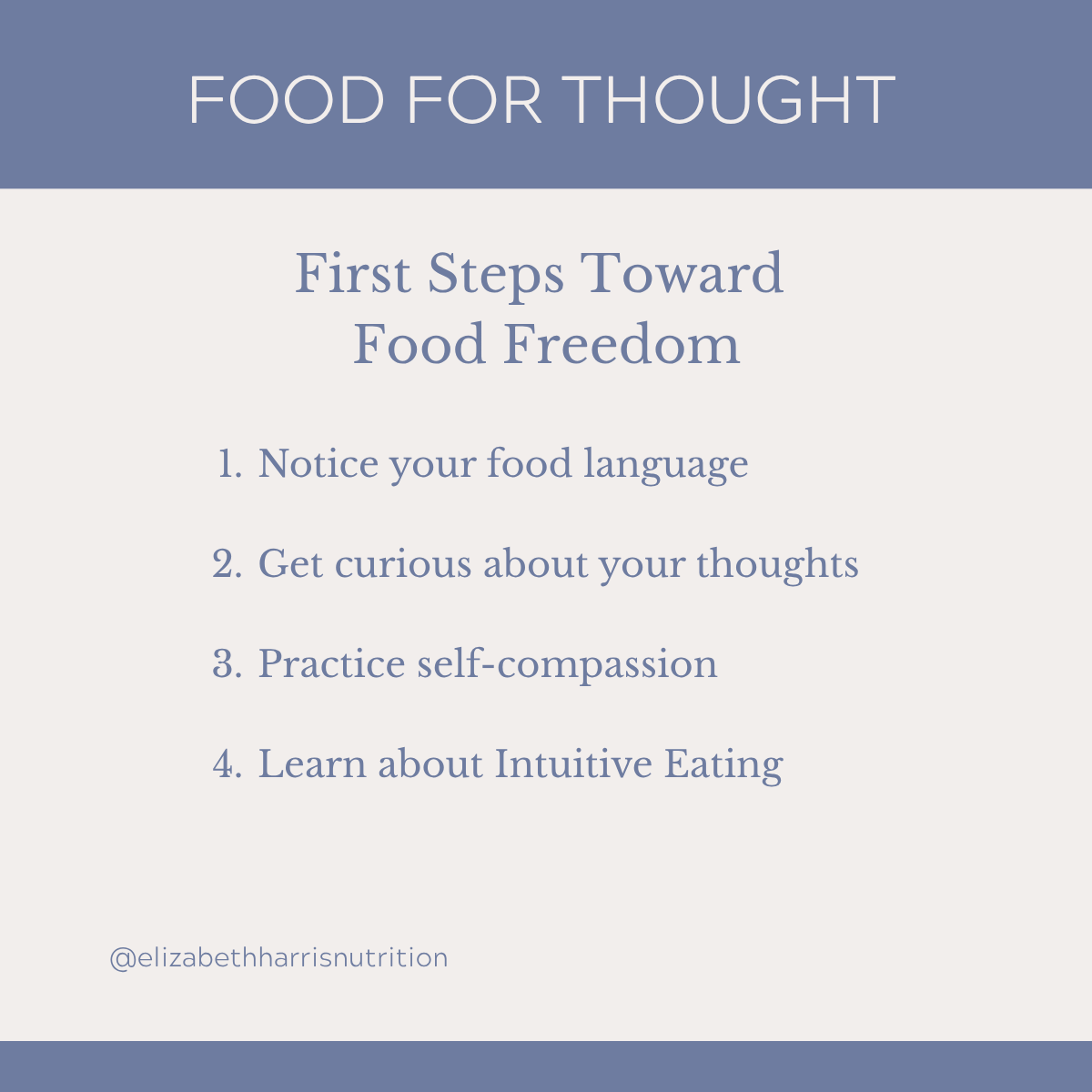
Healing from diet mentality is not a linear process, and it doesn't have a finish line. But there are concrete, possible places to start.
1. Notice the language you use around food.
Start paying attention to the words you reach for when you talk or think about eating. Good, bad, clean, cheat, guilty, deserve — these words may be clues of a hidden diet mentality. You don't need to police yourself for using them; just notice them. Awareness is the first step toward change.
2. Get curious about the thoughts underneath your behaviors.
When you eat past fullness, avoid a food, or feel a spike of anxiety at a restaurant, ask yourself what's happening underneath those feelings. Where do they come from? Where and when did you learn them? What is their impact? Not to judge yourself but simply to learn and understand more about your eating and what drives it. I invite you to take my free quiz, What’s Really Driving Your Eating?, if you’d like some help with this!
3. Practice self-compassion, especially after eating.
This sounds simple but may feel very difficult. When you eat in a way that triggers guilt or shame, the most helpful thing you can do is offer yourself compassion. Not because it doesn't matter, but because shame launches you directly back into diet mentality. Self-compassion is not an indulgence; it’s a proven, helpful tool.
4. Do a deep dive into Intuitive Eating.
The original book by Tribole and Resch is an excellent place to start. I also have an Intuitive Eating Starter Kit that walks you through the ten principles and gives you additional, guided steps to begin understanding and changing your eating patterns and relationship with food.
5. Consider working with a qualified professional.
Diet mentality can be deeply rooted and, as such, untangling it on your own can be challenging. That’s because restrictive thoughts are often so normalized they're almost invisible. Working with a registered dietitian who specializes in Intuitive Eating and a non-diet approach to health (look for credentials including "Certified Intuitive Eating Counselor") can make an enormous difference. A mental health therapist with experience in disordered eating is also a valuable part of the team for many people.
One important thing to note is that not all dietitians work this way. Many still practice within a weight-focused, calorie-restriction model. When you're looking for support, ask specifically about their approach to weight-neutral care and Intuitive Eating before committing. I offer 1:1 counseling to help you heal and transform your relationship with food. If you’d like to learn more, the next best step is to book a complimentary Whole Health Strategy call with me.
You Don't Have to Stay Stuck
If you see yourself in any part of what I've described—whether you've been a chronic dieter for decades or someone who never followed a formal diet but is still deeply impacted by diet culture in ways you're only beginning to name, I want you to know you can heal.
Diet culture is loud, pervasive, and endlessly adaptive. It repackages restriction as wellness, morality as discipline, and shame as motivation. It tells you that you're failing when in reality it’s failed you.
It took me years, and becoming a dietitian educated in Intuitive Eating, to fully understand and see it. I’ve seen women who’ve been stuck battling food and their bodies for decades heal and come out the other side happier and objectively healthier.
When you stop working so hard to make yourself smaller, life gets bigger. More enjoyable. More aligned with the things that matter to you most. And when your relationship with food is solid, it’s so much easier and more enjoyable to build consistent, sustainable, healthy behaviors that support and promote your physical, mental, and emotional wellbeing, or what I like to call your whole health.
Ready to find out where you actually stand with food? Take my free quiz, "What’s Really Driving Your Eating?" It's a great first step toward understanding your underlying beliefs and eating patterns and the steps that will have the biggest impact in helping you make a lasting change.
Or if you're ready to go deeper, I'd love to connect. Reach out here to learn more about working together.
Frequently Asked Questions
What exactly is diet mentality, and how is it different from simply trying to eat healthy?
Diet mentality is a set of beliefs and thought patterns that frame food choices in terms of control, rules, morality, and external standards rather than internal body wisdom. It’s not necessarily about what’s on your plate, but rather about your underlying beliefs and relationship with food and yourself. A wellness mindset is flexible, self-compassionate, and responsive to your body's actual signals. Diet mentality is rigid, rule-dependent, and creates a constant undercurrent of monitoring, guilt, or fear. Diet mentality is often characterized by constant mental negotiation, guilt about meals that didn't go as planned, a determination to always “be good,” or the anxiety you may feel when food feels outside your control. Diet mentality lives in your head as much as it lives in your meals.
What are the warning signs that diet mentality is running the show — including the subtle ones?
The obvious signs are things like calorie counting, frequent dieting, or labeling foods as good or bad. The less obvious ones include exercising to compensate for or earn what you eat, feeling anxious or virtuous based on your food choices, mentally restricting even when you're eating freely (eating the food while simultaneously telling yourself you shouldn't be), defining your self worth by how well you’ve eaten, or not trusting yourself around certain foods or to gauge how hungry or full you are. If you're not sure, ask yourself these questions. Does thinking about food feel neutral? How much negative time and energy does food take up in my life? Those answers can tell you a lot about your relationship with food.
Why does diet mentality tend to get worse in midlife and what does perimenopause have to do with it?
Several things converge in perimenopause and menopause that can intensify diet mentality. Hormonal shifts, including changes in estrogen and progesterone, along with disrupted sleep, can alter appetite and hunger and fullness signaling as well as shift how your body distributes fat and builds muscle. These are normal, expected changes. Your body is not malfunctioning. But at the same time, the wellness industry is saturated with content about fighting these changes, reversing hormonal weight gain, and reclaiming the body you had at 20 or 30.
The thinly veiled message beneath most of it is that your changing body is a problem to be solved. If you're already carrying diet mentality into midlife, that message can stir up some complicated feelings. Women who have relied on restriction and willpower for decades often find that those strategies stop working and they respond by doubling down, which can accelerate the restrict-binge cycle. For many people, midlife is also a season of life when the physical and psychological toll of chronic diet mentality becomes hardest to ignore.
If you stop following diet rules, what replaces them?
Intuitive Eating. It's a framework developed by registered dietitians Evelyn Tribole and Elyse Resch that’s grounded in decades of research. It rebuilds the internal eating wisdom that diet mentality has disrupted, and includes practical skill-building, such as developing hunger and fullness awareness and connection, learning to trust yourself with all foods, practicing gentle nutrition, and building healthy habits, including enjoyable movement.
How does your own diet mentality affect your children?
Children absorb a great deal from watching how the adults around them relate to food and their bodies. Parental food rules, restriction, body commentary, and moralized food language can all shape children's developing relationship with eating. Research is consistent that parental diet mentality is one of the strongest predictors of disordered eating in children and adolescents. This doesn't mean you need to be perfect. It means that your own healing may be one of the most meaningful gifts you can give your kids.
Can you let go of diet mentality if you have a health condition like PCOS, high blood sugar, or elevated cholesterol?
Yes. A weight-neutral, non-diet approach to managing health conditions is evidence-based and effective. The goal is to address health through non-restrictive, inclusive behaviors and sustainable healthy habits rather than restriction and weight loss as the primary lever. This looks different for each person and is best done with the support of a provider who understands both the clinical and relational aspects of food. If your current provider is only focused on weight as the solution, it may be worth seeking a second opinion or consulting with a registered dietitian who practices Intuitive Eating and weight-neutral care.
How do you navigate social environments that reinforce diet mentality?
Diet talk may be everywhere, but you don't have to engage. Some people find it helpful to have a simple, neutral response at the ready. "I'm not focused on dieting right now" or “I’m working on healing my relationship with food, cover most situations without opening a debate. What matters more is building relationships and communities where this kind of conversation isn't the norm, where all bodies are embraced and food isn't moralized. Those communities can aid tremendously in supporting a happier, healthier relationship with food over time.
When does releasing diet mentality on your own require professional support?
If diet mentality has been with you for many years, if it's wrapped up in your identity or your sense of control, if you’re stuck in the restrict-binge cycle, or if you're noticing that your relationship with food is interfering with your daily life or relationships, working can be very helpful and healing. Look for a registered dietitian who is a Certified Intuitive Eating Counselor and who explicitly practices weight-neutral care. A mental health therapist with experience in disordered eating can also be an invaluable support. You don't have to be struggling with a clinical eating disorder to deserve this kind of care.